


Is Metalsmithing in My Blood?
The more I uncover about my family history, the more I wonder whether my love of working with metal was waiting for me long before I ever picked up a hammer.
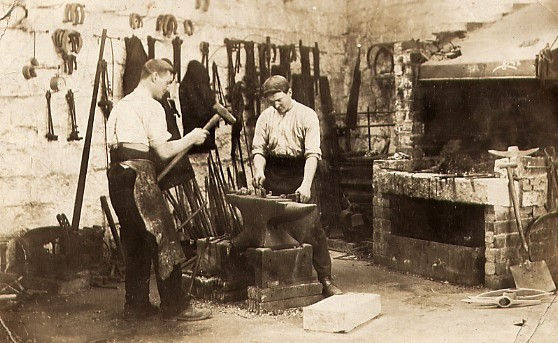
On my dad’s side, my great-grandfather Eddie Oates was the village blacksmith in Pool-in-Wharfedale. In this photograph from around 1910, he is the young man on the left, hammer in hand, working at the anvil in his forge off Mill Lane.
Eddie ran his forge from around 1910 until 1929. He repaired farm gates, shod horses and made the iron railings that once surrounded the whole garden of Pool House, now Church Close. During the First World War, he continued working as a blacksmith while serving in Salonika.
He was not the first metalworker in that branch of the family. Eddie had followed in the footsteps of his grandfather, Michael Oates, who was recorded in the 1871 census as a retired blacksmith living in Pool.
I learned much of this through the research of local historian Pat Lazenby and the wonderful collection of photographs and stories preserved by Pool-in-Wharfedale History. Seeing Eddie at work makes the connection feel much more real. This is not simply a name and occupation in an old record. I can see him standing at the anvil, surrounded by tools, ironwork and the heat of the forge.
Then there is my mum’s side of the family.
Franklin’s Yard in York belonged to members of her family. While tracing its history, the earliest reference I have found to a Franklin living or working there describes him as a whitesmith. A whitesmith worked mainly with lighter-coloured metals and often made or finished objects from tin or iron. The occupation overlapped with tinsmithing, although the terms were not always completely interchangeable. It is another branch of the family, in another place, connected by the same instinct to make things from metal.
A conversation with my mum’s second cousin revealed an even more personal link. Her grandfather did not have much money, so he made jewellery for her grandmother from horseshoe nails. I love the resourcefulness and affection in that story. He took something ordinary and inexpensive, shaped by work and use, and turned it into something beautiful for someone he loved.
Knowing that story inspired me to try it myself. I experimented with a copper horseshoe nail and made it into a slightly abstract ring. It was my own interpretation, but also a small act of connection with a family tradition I might otherwise never have known existed.

So, is metalsmithing actually written into my DNA? Probably not in any scientifically defensible sense. But on both sides of my family I have found blacksmiths, a tinsmith and a man who made jewellery from whatever metal he could afford.
Perhaps that helps to explain why working at my bench feels so natural to me. When I am hammering, shaping, soldering or filing metal, I become completely absorbed. The noise in my head quietens, time disappears and I find that elusive flow state.
Maybe it is simply because I have found something I genuinely love. But when I look at that photograph of Eddie, hammer in hand at his anvil, I cannot help feeling that I am continuing a much older story, even if I have not yet uncovered all of it.


Comments